















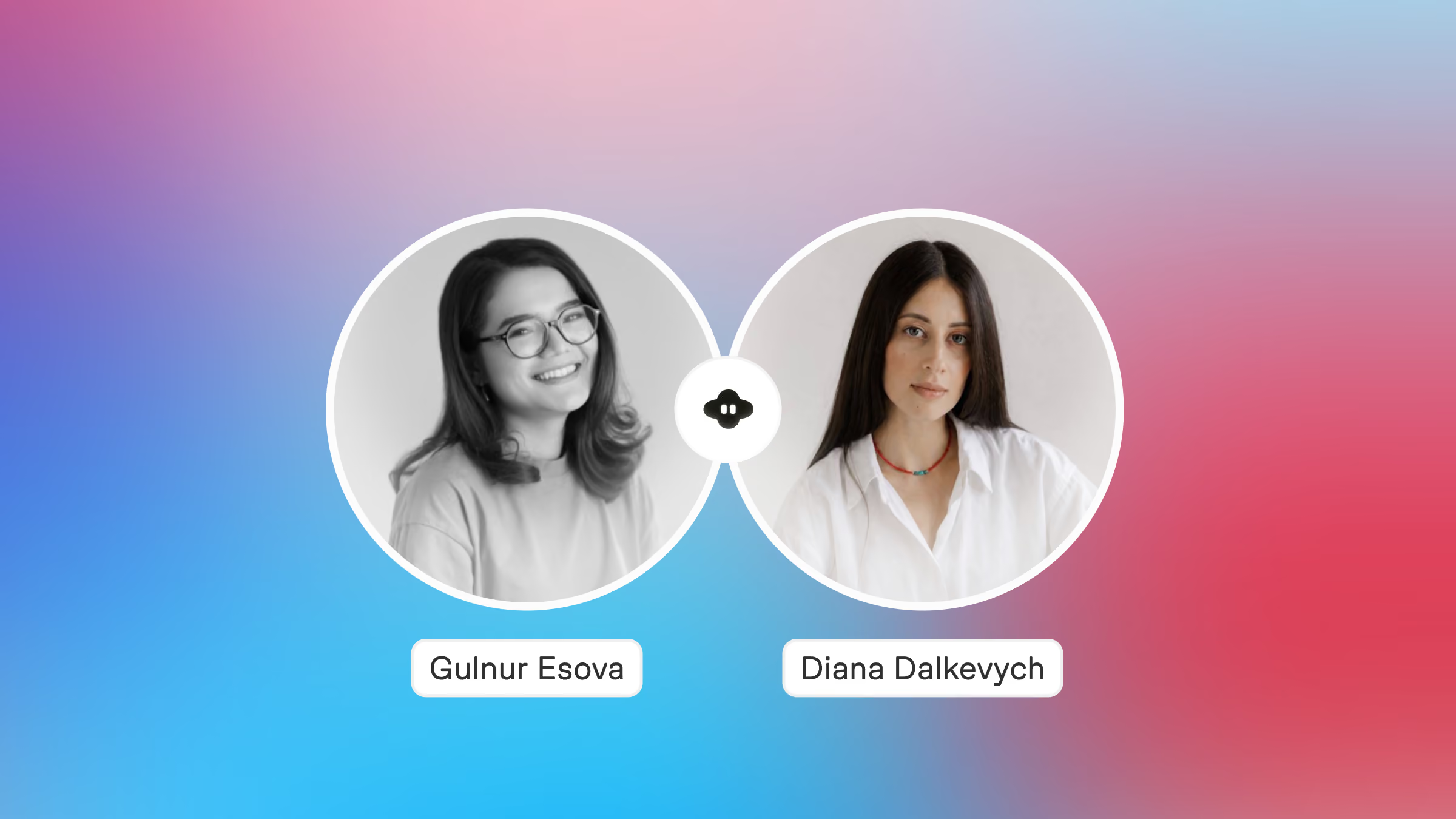
In this interview, we speak with Gulnur Esova, Product Marketing Manager at Moneff, about her experience in payments. We discuss how FinTech teams divide work between employees and agencies, manage rebrands and product launches, choose external partners, and learn from customers.
This interview is conducted by our FinTech Growth Strategist, Diana Dalkevych.
Why outsourcing is the default in FinTech
Diana: Could you tell me about your experience in FinTech and how you started building a marketing function?
Gulnur: I’ve been working in FinTech for the last 4–4.5 years. Before that, I worked in e-commerce as a digital marketer. Now I’m a product marketer in FinTech, mainly in payments.
I was one of the first employees at the company where I joined as a digital marketer. It was a small FinTech company mainly focused on B2C. Later, it was acquired by another B2B FinTech company, Moneff, where I currently work.
I started doing digital marketing by myself. When we started getting customers, we began outsourcing marketing services. We still outsource them.
Diana: What made outsourcing the right decision for that team?
Gulnur: The reason was the product development cycle. For us, it takes 6 months or more.
As a product marketer, I mainly work on how we’re going to take a product to market and how our customers or users are going to use it. If it’s a new product, I’m involved in that whole cycle.
But for someone who works on paid targeting or copywriting, we don’t have that much work until we finish the product. That’s why we decided to outsource most of our marketing activities to agencies.
At the company where I work now, we also outsource most paid marketing and event management. Because of the product cycle, it doesn’t make sense for us to keep a whole team for that. In terms of budget, keeping that team is also a cost for a startup.
We don’t have lots of products. We have payments, and we work on the interfaces for those payments. We don’t need to keep a UX copywriter when we aren’t building a new UX feature every week. We aren’t creating a new partnership every week either, so we don’t need PR support every week. That’s why the product cycle matters to how we organise the work.
Diana: How did your own role change as the company developed?
Gulnur: My role shifted from digital marketing to product marketing. I’m now the person who connects the external and internal teams.
I get feedback from our customers and share it with the product managers. We use that feedback to develop and improve the existing product.
As we get more data and feedback from customers, we can create a feedback loop. Then we can think about creating or adding new products or services.
Branding, website and landing pages: who does what
Diana: How do you divide branding and website work between your team and external specialists?
Gulnur: In 2022, I managed the whole rebranding process. At the time, we had a UX/UI designer, a web designer and a graphic designer.
We brought in branding specialists who could help with our brand mission and vision. We also outsourced some content creation because we wanted to show the story behind the brand.
We outsourced part of the design work, too. We drew and created the design of the new website ourselves, but we outsourced the front-end development.
We wanted to use our internal development resources for product development. So, for the website, we kept the design work within the team and used external front-end services.
Diana: How do your branding needs change once that project is finished?
Gulnur: Branding takes, let’s say, 3–6 months. After that, we don’t need a brand manager in the same way because we’ve established the foundation of what our brand is about.
Then we work around that foundation with content creators — people who write the blog or create video content.
Diana: How do you handle landing pages now, when you have a new product or audience to reach?
Gulnur: We create at least 1 landing page each month to collect leads, or when we have a new product or a new target audience.
We use HubSpot CMS, where we can create landing pages ourselves. We’ve also trained ChatGPT to know our tone of voice. We feed it information about how we work and how we write.
Now our UX and product designers can create landing pages in HubSpot. Recently, we launched a new product for transfers to Uzbekistan. For that page, the designers used Lovable.dev and ChatGPT for the text, with help from our front-end developer.
In 1 day, we had a landing page ready. That’s how it works at the moment: an individual landing page is something we can create ourselves.
Outsourcing it takes time. We have to sign contracts and discuss the details. We already know those details, so we can do it ourselves.
Strategy in-house, execution outside
Diana: Where do you draw the line between the work your team owns and the work you delegate?
Gulnur: We keep the strategic work in-house. It’s about how we see the company and where we’re going.
Take branding as an example. At the moment, our vision is to support Central Asian communities through payments.
First, from the product perspective, we want to make transfers easy and reduce the fees so that they are more cost-effective for customers. The second part is building the community.
The community here from CIS countries, including Central Asia, is growing year by year. We’re taking a step-by-step approach to supporting it.
Building partnerships, supporting the community and creating the product are strategic work for us. We think about whom we can partner with and which direction we’re going to take.
Diana: What does supporting that community look like in practice?
Gulnur: We organised an Uzbek culture and food festival, which was also a strategic step for us. We had a booth there and onboarded customers from Central Asia.
We’re a digital FinTech company, so we don’t normally work with customers face to face. The event gave us that opportunity.
For this, we wouldn’t outsource to a company providing promoters. For us, it was better to use the chance to work with customers ourselves.
We wanted to see how they interacted with the app and listen to their concerns and challenges — both in terms of financial services and in terms of their lives here in the UK.
From the B2C side, we make transfers easier so customers can pay their tuition fees here, send money or receive money from home. Meeting them was a chance to hear about those needs directly.
Diana: How does that community work connect your consumer product with business customers?
Gulnur: We also have a growing community of people who have been living in the UK for 10–15 years and have already started their own businesses. On that side, we help them open business accounts.
With our products, we can also offer discounts through our debit cards. We have a list of partners from the community who have started businesses.
Those include Uzbek restaurants, other restaurants and grocery shops. Customers can get discounts of up to 20%.
So there are several parts to it: making transfers easier, helping people with business accounts, building partnerships and supporting the community through the product.
Diana: Which parts of an event like that would you still outsource?
Gulnur: For execution, we do outsource. At the Uzbek culture event, for example, we outsourced some of the design work — how things should look — and the administrative work involved in organising it.
When it comes to the product and our direction, we keep that in-house. We decide which partnerships to build and what we’re trying to do for the community, and we work with external people on the execution.
How to choose and work with agencies
Diana: When you decide to use an agency, what do you look for first?
Gulnur: We’ve been outsourcing marketing services for almost 4 years, whether that’s events, digital marketing or offline marketing.
What matters to me first is finding someone who works in FinTech. There are lots of agencies: some work in e-commerce, some on the legal side, and others focus on medicine.
My first criterion is an agency focused on FinTech or SaaS — an agency that mostly works with technology companies.
I start with recommendations. After defining that criterion, I get a list of agencies and begin looking at them in more detail.
Diana: How do you turn that initial list into a shortlist you can make a decision from?
Gulnur: I go to their websites and check the reviews, the CEO, the portfolio and any other reviews I can find. Then I get quotes and put together an initial comparison list.
I might start with up to 10 agencies and shortlist around 3 or 4.
Then I speak to people who know the agency, its founder or its team, or who have worked with them. I’ll ask: “What do you think about this agency?” Or: “I saw your company in their portfolio presentation. How was your experience? What were the results?”
If they confirm that they worked together and got results, that helps us narrow the list down.
We would consider a maximum of 5 in detail because we don’t have time to go through all 10 companies.
Diana: Once you have that shortlist, what matters in the final decision?
Gulnur: Budget is one of the main factors that affects our decision. Another part is cultural fit and the agency’s approach to working with us.
We’re a startup, and sometimes an agency’s expectations might be high. They might expect us to keep doing branding activities or creating content continuously. That might not happen.
In a startup, things can change every 2–3 months. The product direction can change. The companies we work with need to be flexible.
We say that upfront. We explain that we’re a startup and that something might happen in the product cycle.
Diana: What does that flexibility look like in practice?
Gulnur: For example, we don’t have many developers. If something happens and we need to hire another developer, that could take 1–3 months. That means another delay to the product.
What’s the point of spending on ads when the product isn’t ready and won’t be ready for some time?
We might say to the agency that we want to pause for 3–4 months. We discuss that possibility upfront, including what happens if something changes in the product cycle.
If that culture and approach work for them, we start working together.
Diana: Do you use different agencies for different markets and types of work?
Gulnur: Yes, it’s case by case. We’ve had good experiences working with Danish agencies, and we’ve also worked with a company here in the UK.
For the Uzbekistan products, we outsource some work there. We work with local media who understand the market, the audience and the language.
We can work with 2 or 3 different agencies at the same time. Over the last 4 years, we’ve had good results from working with them.
That may be part of the reason we haven’t built a whole internal marketing team.
Diana: What does your internal team focus on, and where does customer success fit into that?
Gulnur: We have business development, product marketing, operations and customer success.
For us, it’s important to build the product and, with the help of agencies, bring in customers. Then, from the customer success perspective, we need to keep those customers.
When our customers are happy, they refer their friends. So we get more customers from that as well.


