















.avif)
- Faking reality signals (deepfakes, synthetic IDs, fabricated docs) is now cheap and fast. The "this looks normal" trust model breaks at scale — and not just in regulated sectors.
- FinCEN flagged a 2024 spike in deepfake-linked suspicious activity; FINRA's 2025 report shows the same pattern — synthetic identities, account takeover, GenAI-driven fraud.
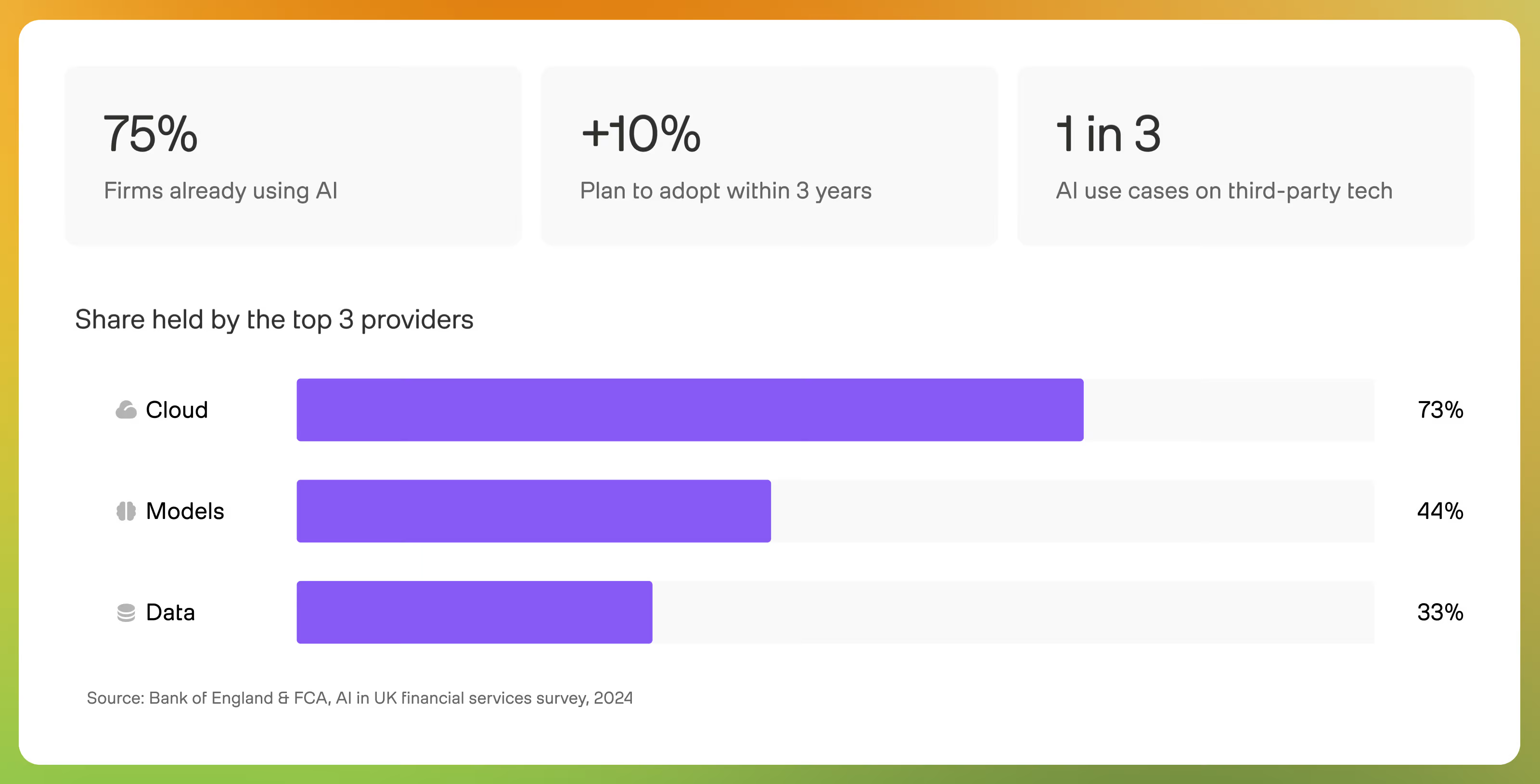
- 75% of UK financial firms already use AI, a third of use cases run on third-party infrastructure (BoE/FCA, 2024). Trust now depends on external systems, not just internal controls.
- Top 3 providers cover 73% of cloud, 44% of models, 33% of data used by these firms. Concentration turns vendor risk into product risk.
- Only 2% of AI use cases are fully autonomous; 55% involve some automation (BoE/FCA). Automation moves fast — accountability still has to stay attached to the decision.
- DORA (EU) and the UK's July 2026 Critical Third Party designation for AWS, Google Cloud, Microsoft, Oracle show regulators now treat dependency itself as a risk category.
- The fix: shorten "reality latency" — the gap between a real-world change and a verified response — by replacing periodic snapshot checks with continuous verification.
Faking the signals we rely on is becoming cheap. And fast. This is the infrastructure change that matters.
High-quality fabrication once demanded skill, money, and time. Those limits created friction. That friction gave institutions room to rely on familiar channels and good-faith assumptions — to expect that a piece of information probably represents reality.
We can no longer make our bets this way because of two critical factors that are no longer the problems: cost and speed.
More and more of the signals of reality checking can now be manufactured, altered, or staged at epically less cost and time than it was five years ago.
We need a different infrastructure: systems for verifying reality, synchronizing with it, and continuously testing the truthfulness of the signals we receive. Not only high-regulated sectors but all sectors now need to solve this challenge.
The market has been shifting
The baseline has to move from “this looks normal” to “what evidence supports this, how current is it, and what action can it safely justify?” Before a consequential action, a product needs a risk assessment. Before it opens itself to a new source, partner, or capability, it needs a threat assessment.
Call this a ‘reality assessment layer.’ It gives a product a disciplined way to stay connected with the world outside its own database.
The lack of it is also seen in what the market is signaling about.
In 2024, FinCEN issued an alert after observing an increase in suspicious-activity reporting connected to deepfake media, including fraudulent identity documents used to bypass verification and authentication. FINRA’s 2025 oversight report describes the same shift in the securities market: synthetic identities, deepfake media, account takeover, and GenAI-enhanced business-email compromise.
At the same time, financial institutions are moving faster into external AI and data infrastructure. The Bank of England and FCA’s 2024 survey found that 75% of responding firms already use AI; another 10% plan to do so within three years. A third of their AI use cases rely on third-party implementations. The top three providers account for 73% of reported cloud providers, 44% of model providers, and 33% of data providers.
That is the shape of the market now: more intelligence, more external dependencies, more speed, and more places where a system can lose contact with what is real.
Regulation has already adjusted to this shape. The EU’s Digital Operational Resilience Act requires financial entities to assess third-party ICT risk, monitor critical arrangements, audit providers, and maintain tested exit plans. In July 2026, the UK designated AWS, Google Cloud, Microsoft, and Oracle as Critical Third Parties to the financial system.
More and more companies are realising the formula of resilience: visible dependencies, continuous assessment, and the ability to act when the context changes.
What can FinTech teach others?
FinTech has spent decades operating under conditions of inherent distrust. That makes it a useful laboratory.
A bank verifies identity. It verifies authority. It checks a transaction against behaviour, context, risk limits, and regulatory obligations. It reconciles records across systems. It keeps an audit trail. It monitors what changes after the decision.
KYC, AML, fraud detection, credit scoring, settlement, and reconciliation all express the same product discipline: a consequential action earns its right to happen through evidence.
These are the practices other sectors can take directly.
- Verify identity and authority separately. Knowing who someone is and knowing what they are allowed to do are different questions. A product needs to answer both before a consequential action takes place.
- Treat a claim as a claim. Record its source, provenance, evidence, confidence level, and freshness. A claim gains weight through the process that stands behind it.
- Match the action to the evidence. A low-confidence signal can recommend, flag, or ask for a review. A high-consequence action needs a higher proof threshold.
- Reconcile independent views. A dashboard is a view of reality. The product needs to show how that view was formed and where signals disagree.
- Let trust expire. A supplier, customer, document, or model can change after the last check. Time belongs inside the trust model.
- Make decisions reconstructable. When something goes wrong, the team needs to see the facts, rules, permissions, and human decisions that produced the outcome.
Zero trust gives this discipline a useful technical language. NIST defines it through the removal of implicit trust based on location, ownership, or affiliation. Access follows authentication, authorization, and continuous assessment.
The product version is equally simple: data, identity, permission, model output, and internal process earn trust through evidence.
Where FinTech still gets stuck
FinTech has the building blocks. The larger task is to join them into an adaptive system that sees the world as it changes.
- Controls arrive in snapshots. Onboarding, KYC refreshes, compliance reviews, and vendor assessments establish an important baseline. The real world keeps moving between them. A system needs to recognise when an old verification has lost its value.
- Evidence remains fragmented. Customer data, transaction data, fraud signals, external intelligence, and human judgement often sit in different systems. Each system can be accurate. The decision still requires a view across them.
- Third-party risk has become product risk. External data, cloud, models, and infrastructure now sit inside the customer experience and the decision path. The Bank of England and FCA data make the concentration visible. The product needs to understand its own dependencies in real time, rather than treat them as a procurement record.
- Compliance and product speed pull in different directions. Compliance establishes necessary controls. Product teams carry the pressure to make every interaction faster. The next architecture has to make speed and control work as one system.
- Human judgment enters too late. A review queue can contain an exception. It does not create a way to resolve a conflict between credible signals, nor does it show the customer why the product made its choice.
These gaps turn a strong control stack into a slow and partial view of reality.
The unfinished work: what FinTech needs to solve next
FinTech enters this work with unusually strong conditions: high-stakes decisions, mature risk practices, dense data flows, and regulatory accountability. The next step is to turn those assets into a faster and more independent trust infrastructure.
Shorten reality latency. I call the gap between a change in the real world and a validated response to it ‘reality latency.’ A fraud pattern appears. A counterparty becomes risky. A customer’s circumstances change. A data source loses integrity. The longer a product takes to recognise the change, verify it, and decide what to do, the more risk it carries forward.
Speed measures something bigger than user experience: it measures the time between a real-world change and a response that deserves trust.
Continuous verification keeps the checks and changes their rhythm: automation handles clear evidence, people enter where judgment carries the consequence, and every decision remains available for inspection.
The Bank of England and FCA survey found that 55% of reported AI use cases involve some degree of automated decision-making, while only 2% are fully autonomous. Automation moves work quickly; accountability stays attached to the decision.
- Build independence of evidence. Objectivity grows from independent evidence. A strong system compares sources, exposes disagreement, and makes its reasoning visible, so no company, model, or data source silently defines reality for everyone else.
- Create controlled permeability. External technologies, partners, specialist human judgment, and new data sources will keep entering financial products. They need a safe path in: verifiable identity, scoped permissions, clear provenance, real-time monitoring, audit rights, and the ability to revoke access or leave the relationship when conditions change.
- Unify risk assessment and threat assessment. Risk asks what the cost of a decision can be. Threat asks who or what can exploit the path to that decision. Products need both views inside one operating model, tied to concrete actions, permissions, and escalation paths.
- Place human judgment at the point of consequence. A review queue handles exceptions. Strategy places people where ambiguity, materiality, or a conflict between signals requires a decision with real judgment behind it.
And, yes, it is difficult. It really is. A product has to move fast enough to remain useful and carefully enough to remain real.
Speed without evidence is faster exposure. Verification without speed arrives after the damage. The next generation of FinTech products has to carry both.
Why FinTech leads — and what other critical sectors already know
FinTech remains the focus here. It is one of the strongest testbeds for this infrastructure because it processes trust at operational scale, carries the cost of error directly, and already has systems for identity, authorization, fraud, reconciliation, and audit.
HealthTech and DefenceTech belong in this conversation as reference points, not as a second story. They already work with the same raw materials: authorised actors, high-consequence decisions, evidence requirements, auditability, and a duty to stay safe when the context changes.
HealthTech brings clinical validation, patient-data responsibility, and post-market monitoring. The FDA maintains an actively updated list of AI-enabled devices authorized for marketing in the United States, alongside guidance on lifecycle changes and cybersecurity.
DefenceTech brings secure data sharing, explicit chains of responsibility, and operations inside a contested information environment. NATO’s AI strategy places responsible use, testing, and interoperability at the centre of adoption.
The sectors have different stakes. They share the same unfinished infrastructure question: how does a system know what is real, who can act, what evidence supports the action, and when the answer has changed?
FinTech can lead the work because its feedback loops are already tight. The patterns it proves will travel.
The direction of innovation
Across sectors, innovation has focused on capability: more data, more automation, more integrations, more output. That work matters. The next direction is to build products that can remain in contact with reality while they use all of it.
- Move from information to validated action. A product becomes useful when it helps someone act. The action needs a visible evidence threshold, a risk level, and a record of why it happened.
- Move from static control to continuous assessment. A quarterly review or one-time verification establishes a baseline. Real-world changes need to update the system’s view while decisions are still reversible.
- Move from closed systems to controlled permeability. Partners, external models, human specialists, and new data sources will keep entering products. The job is to let the right capabilities in through clear identity, scoped access, provenance, monitoring, and exit paths.
- Move from automation to accountable human-machine systems. Automation should carry clear evidence quickly. People should make the calls where ambiguity, materiality, and competing signals require judgement.
This is the innovation agenda now. Build systems that can move quickly, explain themselves, and stay grounded in what is actually happening.
The competitive advantage is contact with reality
The advantage will belong to the company that sees reality sooner, through more than one source, and can explain why it acted.
Trust has to be built. It has to be verified. It has to be inspectable. And it has to be updated continuously.
Reality does not care whether our systems are ready for it. It is what it is.
The question is what we choose to build around it.

Learn about our Editorial policy